Deterministic test data for banking and insurance
DATAMIMIC is the test data platform for regulated banking and insurance. It generates deterministic, reproducible, CI/CD-ready test data, including valid ISO 20022 and SWIFT messages, without production data ever leaving your environment.
Connect a database or import JSON, model entities and relationships once, then run it from any pipeline via REST/OpenAPI. Referential integrity holds across tables, collections, and deeply nested payloads.
Key Benefits
Model-based control
Define precise structures and rules to enforce strict referential integrity. Ensure consistent test data management across complex applications.
Deterministic Generation
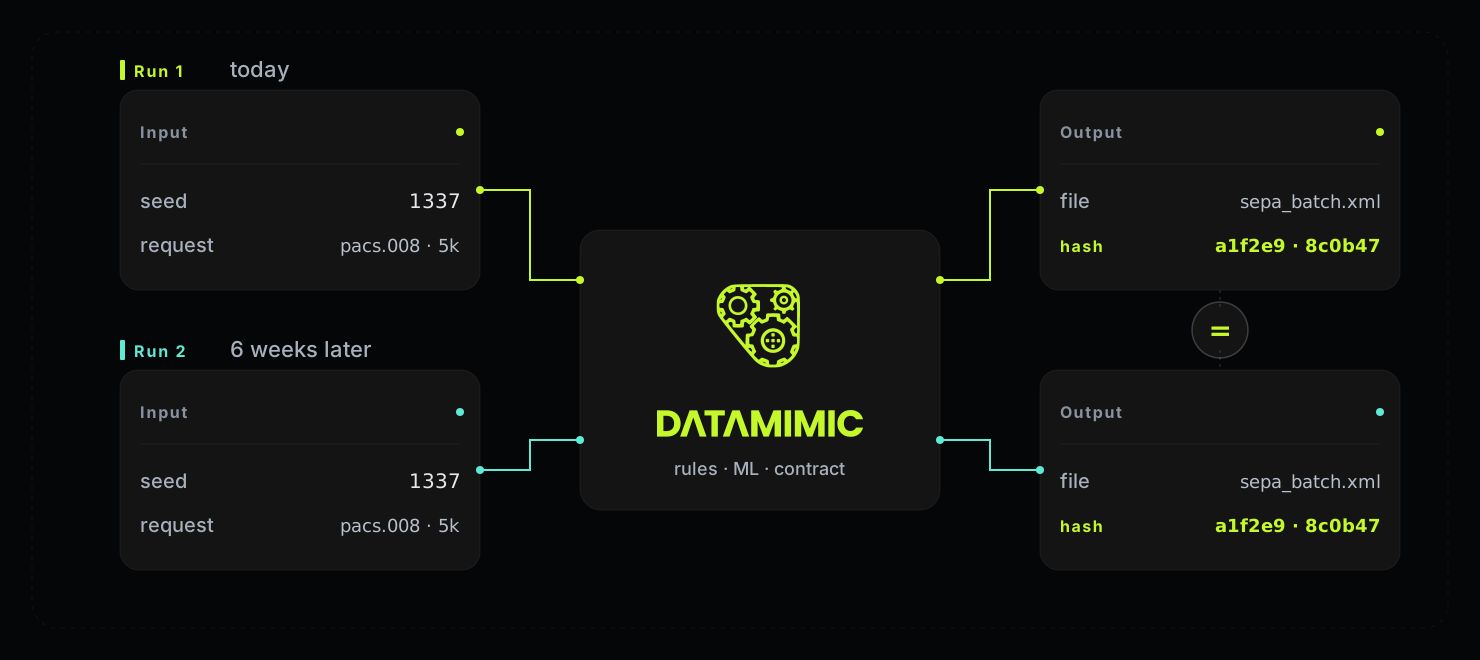
Same engine version, same model, same seed, byte-identical output, on any machine, months later. Model-driven generation needs no production data to begin with.
JSON/XML mastery
Advanced handling of complex JSON and XML including deeply nested, API-style payloads used in microservices.
Compliance-first
De-identification techniques (tokenization, format-preserving encryption, pseudonymization, field-level masking) for teams measured against GDPR Art. 25, DORA and BCBS 239. Every run is logged and traceable.
CI/CD friendly API
Automate generation in pipelines via REST and run headless in DevOps/CI to seed test environments on every build.
Visual modeling
A clear layer to inspect quality checks & relations so data stewards can validate models in a data-quality framework.
How it works
DATAMIMIC connects directly to your databases or ingests files like JSON to auto-generate a model of your data, then lets you refine entities and relationships so generated datasets stay consistent across tables, NoSQL collections and deeply nested JSON/XML. Because it’s model-based, outputs preserve referential integrity and support trusted data solutions for test, dev and training. Through documented REST/OpenAPI endpoints you can run it headless in CI/CD to keep test environments consistently seeded without copying production data.
Use cases
Teams use DATAMIMIC to build realistic, privacy-compliant datasets for QA and staging without exposing production records, to run integration and end-to-end tests that depend on stable cross-entity links (customers ↔ orders, payments ↔ accounts), and to produce API-ready, JSON/XML payloads for microservice and banking/fintech scenarios — all inside a GDPR-compliant, synthetic-data workflow.
Ship faster with privacy-safe test data that mirrors your systems.
DATAMIMIC generates realistic, synthetic datasets from a model of your structures, so relationships stay intact across tables and even deeply nested JSON/XML. Because it’s built for regulated teams and GDPR-friendly workflows, you can test without exposing production data—and you can trigger generation headlessly via REST/OpenAPI in CI/CD to keep staging consistently seeded.
Deploy DATAMIMIC as SaaS or on-premise—via Docker/Podman or Helm on Kubernetes/OpenShift—and use the visual modeling UI to inspect entities, define data-quality checks, and enforce referential integrity; then automate generation through the REST API with project access tokens, or keep projects versioned by syncing a DATAMIMIC project to a specific Git branch so test-data definitions stay in lockstep with your codebase
See DATAMIMIC in action
Explore real projects where teams used model-based synthetic data to move faster and stay compliant — from a European tier-1 bank that took test-data preparation from 20 to 28 days down to about 12 hours per cycle across Oracle, MongoDB and Kafka, to a public-sector education platform that replaced 10,000 lines of custom Python with 1,200 lines of DATAMIMIC models across roughly 30 schemas, with no real student data in non-production. See how trusted data solutions from DATAMIMIC removed the need for manual masking while keeping data realistic enough for E2E and API tests.
Automate in your pipeline
Hook DATAMIMIC into your delivery process with the documented REST/OpenAPI endpoints, run it headless to provision synthetic data on every build, and even sync projects to a Git branch so test-data definitions stay in lockstep with your codebase. This lets DevOps teams enforce repeatable, GDPR-compliant test data and ship under regulatory pressure with trusted data solutions. For trials or support, contact the team.
F.A.Q
Frequently Asked Questions.
Frequently Asked Questions about working with us
What is the difference between data anonymization and pseudonymization?
The distinction is crucial under GDPR. Anonymization alters data so that individuals can no longer be identified, even when it is combined with other information. Such data is no longer personal data. Pseudonymization replaces direct identifiers with a pseudonym but still allows attribution through separately stored additional information. Pseudonymized data therefore remains personal data (Art. 4(5), Recital 26).
DATAMIMIC supports both techniques, and the mode is a deliberate choice, not a side effect. With a seed set, output is deterministic and reproducible; the result is pseudonymization. Without a seed, output is not reproducible and transformed fields are irreversible. That alone is not sufficient for record-level anonymity: quasi-identifiers such as age, postal code, timestamps, or amount patterns must also be generalized or suppressed. DATAMIMIC identifies these fields in its risk assessment and provides the converters needed to coarsen them.
Is synthetic data as good as real data for testing?
Better in several respects, worse in one, and the difference is predictable. Better: A production copy is a perfect snapshot of normal cases and misses exactly the edge cases needed in testing. Rare combinations remain rare in the extract. From a model, you can generate them deliberately and in any quantity, as well as states that do not yet exist in production, such as a message format before a migration or a data volume for a load test.
Worse: A model only knows what has been modeled. Irregularities present in your production data but never described do not appear in the synthetic dataset. That is why DATAMIMIC starts with a model of your real structures rather than a generic template, and why the model remains an artifact that must be maintained.
How does DATAMIMIC help comply with GDPR and other data protection regulations?
Production copies in test and development environments are a standard case of unnecessary exposure: more authorized users than in production, longer retention, and weaker controls. DATAMIMIC addresses the root cause. Test data is created from a model; production records are not required for generation. Where real data must be used, de-identification techniques run within your environment. This directly addresses data minimization under GDPR Art. 5(1)(c) and Privacy by Design under Art. 25.
Compliance remains a property of your overall processing, not of a single tool. What DATAMIMIC contributes is evidence: every run is logged with a task ID, timestamp, model version, and content hash and can be reconstructed identically months later. If that evidence is missing, the system blocks the operation instead of silently taking an alternative path.
Can DATAMIMIC work with our existing databases and CI/CD tools?
Yes. Native connectors for PostgreSQL, Oracle, MongoDB, and Apache Kafka, plus SWIFT MT, HL7, and EDIFACT. The REST/OpenAPI endpoints are documented and integrate Jenkins, GitLab CI, or Azure DevOps. Run it as SaaS, on-premises via Docker/Podman, or with Helm on Kubernetes and OpenShift, including fully offline operation without telemetry or call-home.
Does DATAMIMIC generate valid ISO 20022 messages?
Yes. pacs.008 and pain.001 in the ISO 20022 space, MT103 and MT202 COV in the SWIFT MT space, plus EDIFACT and HL7. Messages are valid against the relevant schema by construction, not validated afterward. For camt messages, validation against the stored schemas is currently available; generation is not yet available. You can download, adapt, and re-import your own or differing specification versions without waiting for a release.
How does DATAMIMIC fit into our development process?
Through the platform, not around it. A DATAMIMIC project bundles models, environments, and permissions and can be synchronized with a Git branch so that test-data definitions carry the same version as the code. The DATAMIMIC extension brings this project context into the editor. Schema validation, autocompletion, and error diagnostics come from a language server operated by the platform for the authenticated project. No schema or environment knowledge is therefore stored as a local copy outside your platform. The same interface is available to a coding agent working in the editor. Execution still runs through the platform: the same permissions, the same approval, and the same audit log as a run started from the UI. The editor shortens the path; it does not open a second one.
Ready to generate safe, realistic test data?
Clear next steps — read the quickstart or book a short call; we’ll map entities, relationships, and CI/CD triggers together.

